
NBWC Assists Tribes in Opposing Large Graphite Mine in Imuruk Basin
Updated: Aug 4
Graphite One, a Canadian-based mining company, seeks to extract ore from what may be the highest grade and largest graphite deposit in the United States. The mine will include an acid-generating open pit that will be over a mile in length, and approximately ¼-mile deep would have substantial impacts on one of the most biologically rich watersheds in the State. Similarly, the mining company projects the removal of 22.5 million tons of ore at the rate of 2,740 tons per day with an additional 50 million tons of waste rock and the diversion of the entire flow of Graphite Creek within the footprint of the mine. A flotation processing plant located at the mine site is projected to produce 53,600 dry metric tons of concentrated graphite per year for transport via a new road constructed through the Kigluiak Mountains to the Port of Nome, Alaska, and subsequent shipment to battery manufacturing facilities in the lower 48 states.
With Mining Increasing in Alaska, State’s Permitting Process Appears to be Broken
While mining projects are dramatically increasing in Alaska under the Trump and Dunleavy Administrations’ pro-extraction policies, citizen oversight of permitting is virtually nonexistent. The problem can be traced back to 2003, when the Alaska legislature eliminated the “public interest litigant” rule that protected anyone without economic incentive, who was challenging decisions involving public lands, waters, fish or game. Now Alaska is the only state in the Country to require the losing party in such lawsuits to pay for all or a part of the prevailing party’s attorneys’ fees.
Legal experts claim that because the “Loser-Pays-Rule” is clearly intended to discriminate against the general public who might be considering filing good-faith environmental protection claims, it violates the concepts of fundamental fairness contemplated by the Bill of Rights and the U.S. Constitution. Specifically, in describing the legal obligation of state governments, the Fifth Amendment states that no one shall be "deprived of life, liberty or property without due process of law." Then, in the only instance in which a prohibition is stated twice in the Constitution, the Fourteenth Amendment repeats the identical terms in what has been referred to as the “Due Process Clause” which mandates that governmental entities must provide fair process before depriving a citizen of the United States of life, liberty, or property.
That Alaska’s Loser-Pays-Rule has had a chilling effect on good-faith public-interest law cases, is illustrated by the fact that non-profit organizations and tribal organizations have dramatically slowed the filing of environmental protection lawsuits. According to Trustee’s for Alaska a public interest law firm based in Anchorage that focuses on such cases, “[t]his policy creates a chilling effect, deterring people from going to court to ensure protection of our lands and waters. When citizens do not have access to the courts to challenge government or industry it hands a free pass to those that would issue lax permits, purposely violate the rules or take advantage of poor oversight when it comes to coal mining in Alaska.”
A recent example of this chilling effect is a permit to conduct exploratory drilling in the Imuruk Basin of Northwestern Alaska, issued by the Department of Naturual Resources to the Graphite One Mining Company. After several tribes and the Norton Bay Watershed Council appealed the permit, citing concerns about impacts to subsistence and cultural resources in the biologically and culturally rich area, DNR found the appeal deficient, claiming that it had not been property signed. Although the Tribes fully complied with the express language of 11 AAC 02.030(a)(3) in filing the appeal, essentially the agency read its own interpretation into the regulations requiring that the appellants correct the deficiency. The correction however, required a longer process to obtain signatures and to re-file the appeal allowing the drilling to run its course.
While one could say that DNR could not have legitimately acted on the appeal until after it had been properly filed or stopped the drilling until that occurred, another appeal of the permit submitted was similarly swept under the rug. Austin Ahmasuk an activist who has long been a protector of the Imuruk Basin who submitted that appeal said “I have not received any response regarding how the appeal or stay request was handled. In that sense, it feels as though the appeal has effectively been ignored.”
Whether it is because DNR knows that it is highly unlikely that it will be taken to court or some other reason, it appears that the public process is broken. According to Ahmasuk:
…What happened with this land use permit appeal is not just about a single project. It highlights broader concerns about whether Alaska's regulatory system is providing meaningful opportunities for public involvement. When communities invest the time and effort to participate, their concerns deserve to be heard and considered before decisions are finalized.
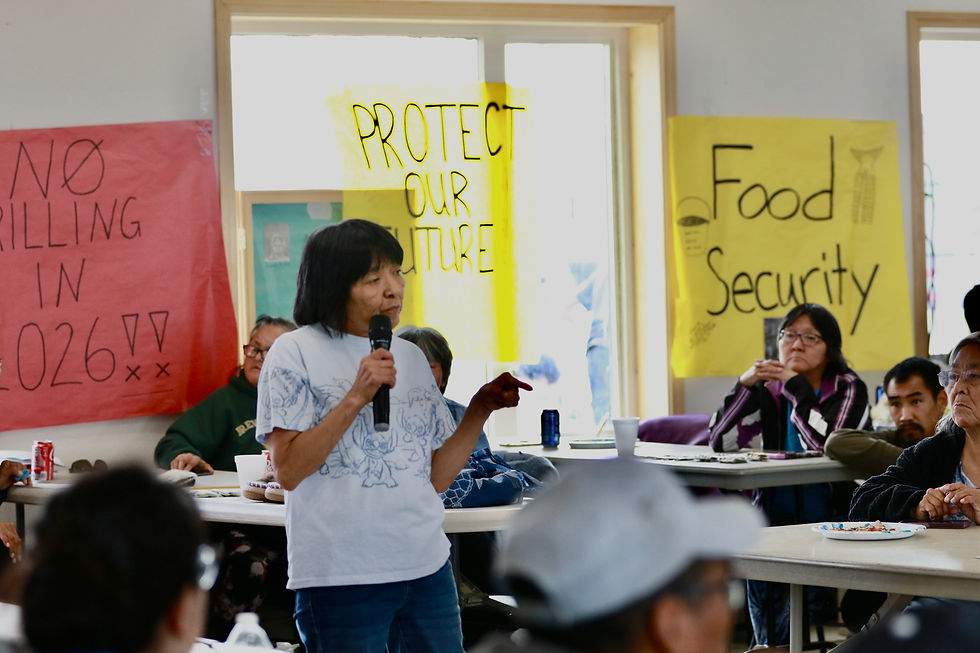
Graphite One likes to say that the impacts of the proposed 1.1 mile wide open pit mine that includes a 17.3 mile access road, will be all but eliminated because, the mining company will be required to obtain a couple of dozen State permits that are supposed to protect water flow and quality, air pollution, cultural resources, and multiple other potential impacts. But if what happened with the drilling permit is any indication, it’s beginning to look like the state will simply rubber stamp the permits and then ignore any appeals. As such, at a packed community meeting about the proposed mine, recently held in Brevig Mission, even the Mining Company expressed dismay that the state swept the challenges to the drilling permit under the rug. Ed Fogal who Graphite One’s Environmental and Permitting Manager said “I wish they had just made a decision on the appeal.”
It seems, in part, due to the ramifications of the Loser-Pays-Rule, the State is of the opinion that as far as mining permit issuance and enforcement, it can do anything it wants without having to worry about repercussions. This is clearly an issue that should be raised with legislators in Juneau who need to understand how difficult it can be for rural communities and Tribes to engage in the permitting processes and what happens when the system fails to respond in a timely and meaningful way.
Graphite One Mine’s Impact on Rivers and Streams

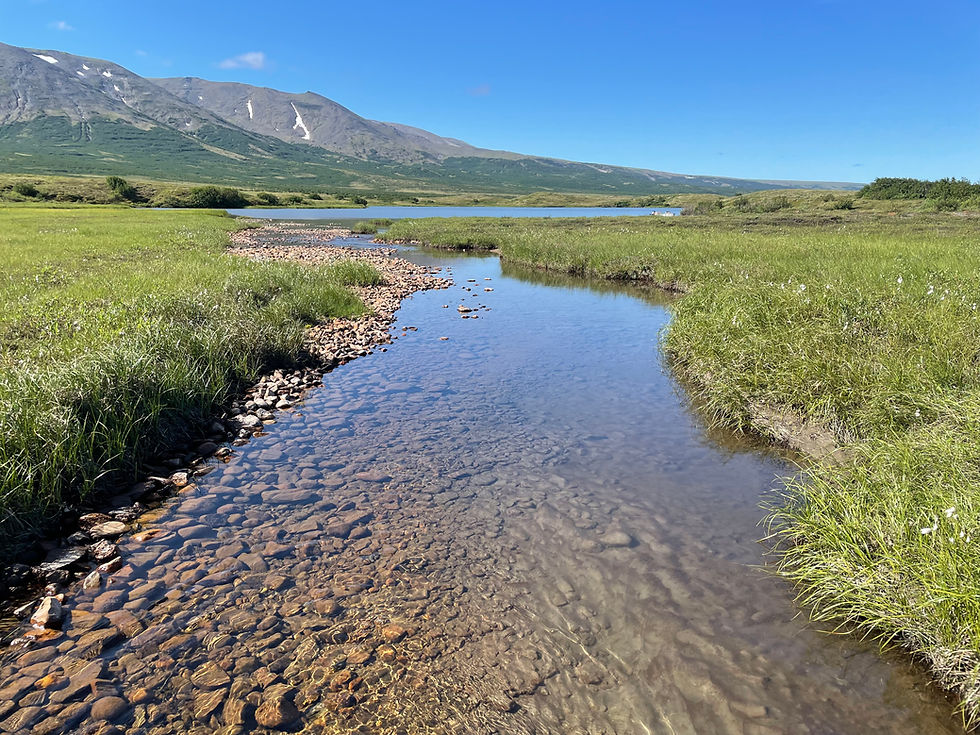
The Graphite One Mine intends to divert toxic effluent from the mine into and divert two salmon streams that are within the 1,176 acre foot print of the mine. The mining company claims that the pristine Glacier Canyon Creek (Picture above) and Graphite Creek do not contain salmon or other fish species because they contain back ground levels of heavy metals and are too acidic and therefore intends to dump so called “treated” effluent into Glacier Canyon and divert Graphite Creek around the open mining pit. However, it is ironic that while all the other rivers and streams within 2 miles of the mine contain abundent salmon except for these two creeks and the Fish Surveys that the mining company and the Alaska Department of Fish and Game are relying for the claim that these rivers do not contain salmon are flawed.
NBWC and the Native Villages of Teller, Mary’s Igloo and Brevig Mission will be conducting their own fish surveys in Glacier Canyon and Graphite Creeks during the 2026 field season to find out the truth about the existence of salmon in these creeks.
Tribes Convince Army Corp of Engineers for Environmental Impact Statement on Mining Project in the Sacred Imuruk Basin
The U.S. Army Corps of Engineers has decided to draft a more comprehensive Environmental Impact Statement rather than an Environmental Assessment for the controversial Graphite One mine that would be located in the Imuruk Basin of Northwestern Alaska. According to an e-mail received by the Native Villages of Brevig Mission, Teller and Mary’s Igloo (Tribes) on July 9, the agency has also “determined that additional time is needed to conclude our Section 106 Consultation process under the National Historic Preservation Act.”
Graphite One, a Canadian-based mining company, is applying for a federal permit for a 1.1-mile-long open-pit mine in Alaska’s remote Kigluaik Mountains. Access to what the mining company claims is the largest graphite deposit in the United States would also require construction of a 17.3-mile-long road cutting across salmon streams and archeological sites, and water withdrawals from over a dozen streams, further jeopardizing already low numbers of chum and pink salmon returns at a time when climate change is warming the region.
The Tribes and their partner organizations have consistently called for adequate environmental and cultural impact analysis as part of Graphite One’s permitting process, given potential impacts on community health, subsistence, water, and cultural resources. Nevertheless, last year the Corps issued a Notice of the mining company’s application for a Section 404 permit under the Clean Water Act and announced that, under the so-called Fast-41 process, it would likely complete the less involved EA rather than an EIS so that the permit for the Mine could be issued by this September. As a result of this announcement, opposition to the truncated review and to the Mine grew substantially and now includes tribes, tribal organizations, and the local community in the region.
Up until the decision to conduct an EIS, the Tribes had been concerned that, to encourage the Corps to limit the Mine’s impacts, Graphite One arbitrarily underestimated the potential impacts on wetlands and watersheds as part of a Jurisdiction Determination Report submitted to the agency. Additionally, the decision to draft an EIS as part of the permitting process is somewhat surprising, given that the Corps has been under pressure to implement proposed limits on Clean Water Act protections and to implement Trump administration executive orders that promote industrial extraction and mining of critical minerals in Alaska.
As a result of the recent decision, under FAST-41, the Corps has changed several milestone dates and added an EIS action to the Permitting Timetable. The new deadline to complete the EIS and issue the permit for the mine is September 2027, and the deadline to complete the Section 106 review under the National Historic Preservation Act is March 2027.
For its part, Graphite One maintains that it supports the Corps decision. According to Anthony Huston, President and CEO of Graphite One, “We fully support the Army Corps’ recommendation to conduct a comprehensive EIS review. This approach ensures transparency and provides the opportunity for all stakeholders—including local communities, Indigenous groups, and regulatory agencies—to have their voices heard and concerns addressed in a thorough manner.”
This is an about-face from the Mining Company’s initial stance when it pushed to keep the Corps from conducting an EIS. As illustrated by an e-mail to the Nome Nugget sent by Graphite One Senior Vice President Kevin Trophy last November, which states “after reviewing our project plan, the Army Corps of Engineers determined our project will not impact enough wetlands to necessitate an EIS…Given the very small wetlands footprint, the Corps made the initial decision to schedule the project as an Environmental Assessment (EA)…” It’s possible that the sudden change of heart is due to the fact that the mining company does not expect a delay in the project’s permitting timeline. “Graphite One anticipates that the EIS schedule will align with State of Alaska permitting requirements and does not expect any delay to the proposed 2029 production startup date for the Graphite Creek Project.”
The tribes believe that the original extremely low impacts estimate was based on the anticipation of a new federal Rule that would eliminate Clean Water Act protections for the vast majority of wetlands throughout the Western U.S. and Alaska. Because the Corps is one of two federal agencies that is directly involved in drafting the latest proposed Rule, there has been speculation whether Graphite One’s originally low estimates of the Mine’s impacts were because they had been working with the Corps to apply the highly restrictive definition of the draft Rule to such impacts even before it is finalized.
According to the Corps, the startling about-face on the significance of the Mine’s impacts is based on multiple factors; however, the Tribes point to increasing local opposition, including several public meetings and Government-to-Government consultations between the Corps and the Three Tribes last spring, in which the Tribes and local communities expressed overwhelming opposition to the mine and implored the agency to conduct a full EIS.
According to Kacey Okbaok, President of the Native Village of Teller Traditional Council: “The public meetings last spring in Teller and Brevig Mission as well as Nome were packed and not a single person at those meetings spoke up in favor of the mine. During these meetings, we attempted to convey to the Army Corps of Engineers how critical the subsistence and Cultural resources are to our communities. We thank all of the tribes, tribal organizations, and community members who have stood with us to obtain adequate analysis of the impacts of this proposed mine.”
Tribes Opposing Mine in the Arctic up against Trump Administration’s Attack on Clean Water
Access to what is likely the Graphite One Mine will require the construction of a 17.3-mile-long road cutting across salmon streams and archaeological sites, and water withdrawals from over a dozen streams, further jeopardizing already low numbers of chum and pink salmon returns at the exact time climate change is warming the Arctic.

The Native Villages of Teller, Brevig Mission, and Mary’s Igloo, and their partner organizations, have consistently opposed Graphite One’s permitting process, conducted by the U.S. Army Corps of Engineers, due to potential impacts on community health, subsistence, water, and cultural resources. And in recent weeks, that opposition has been mounting. On November 21, the Native Village of Brevig Mission Traditional Council and Village Corporation, and the City of Brevig Mission, unanimously adopted a resolution opposing the Mine. Then, the day before Thanksgiving, representatives from the City of Brevig Mission, the Brevig Mission Traditional Council, and the Native Corporation traveled across the ice-covered Grantly Harbor to meet with their counterparts in Teller to discuss further the impacts of the Mine. At the meeting, the Teller Tri-Entities and the Mary’s Igloo Traditional Council adopted more resolutions opposing the Mine and launched a comment-writing campaign for members of the public who attended. Then, on the following Friday, the three Tribes, along with the Norton Bay Watershed Council, submitted voluminous comments to the Corp, adding to a growing stack from other organizations and community members that point out multiple flaws in the Mine’s permitting process.
These flaws arise primarily out of the Corps’ obligation under the Clean Water Act to fully study the impacts of the Mine on the Imuruk Basin, an area that is almost as much water as it is dry land and is known as one of the most biologically productive and culturally rich regions in North America.[1]
The Tribes are primarily concerned that the agency is fast-tracking the application under the federal Fast-41 process,[2] and, ignoring proper analysis of environmental impacts in order to implement Trump administration executive orders favoring industrial extraction over protecting subsistence and cultural resources.[3]
A major component of the Tribes’ argument is that, to encourage the Corp to limit analysis of the Mine’s impacts, Graphite One has arbitrarily underestimated the potential impacts. Specifically, out of over 15,000 acres of land and waters within the Mine’s study area, Graphite One has estimated that the total extent of permanent impacts to wetlands and other waters would be a mere 414.68 acres and that only 2.21 acres of that are “jurisdictional” requiring analysis before the permit is issued under the Clean Water Act.[4]
The awkwardness of such low balling, however, is illustrated by a Jurisdictional Determination Report created by the consulting firm hired by the mining company to support its claim which concludes that the total extent of permanent impacts to wetlands and other waters would actually be 5,931.4 acres and the total jurisdictional waters would be 581.0 acres, greatly exceeding Graphite One’s estimated impacts.[5] In addition, while the Clean Water Act may limit environmental analysis to rivers, streams and wetlands that come under its jurisdiction, the National Environmental Policy Act requires the Corp to analyze impacts on dry land as well and therefore the entire 15,000 acres of the study area.
That the Corp appears to have bought into the ridiculously low levels of impacts of over a one mile wide mine and an over 17 mile access road as illustrated by an e-mail to the Nome Nugget newspaper sent by Graphite One Senior Vice President Kevin Trophy which states “after reviewing our project plan, the Army Corps of Engineers determined our project will not impact enough wetlands to necessitate an EIS…Given the very small wetlands footprint, the Corps made the initial decision to schedule the project as an Environmental Assessment (EA)…” thereby conveniently avoiding a complete analysis of impacts and a much reduced timeline for permitting.
To understand how this came about, one must first go back over the past decade or so, when a series of republican administrations’ primary tool for dismantling the Clean Water Act has been to drastically limit its scope.[6] Although Congress defined “navigable waters“ under the Act broadly to simply mean “Waters of the United States” (WOTUS), starting in 2001, a succession of U.S. Supreme Court opinions concluded that Congress’ use of the term “navigable waters,” somehow indicated an intent to restrict protections to only those waterways (including wetlands related to such waters) that have been traditionally navigable and ignored its previous finding that the term “navigable” was not that relevant to which waters were covered by the Act.
With 174 million acres of wetlands, more than three million lakes, and more coastland than the lower 48 combined, no other state has more to lose from weakening the definition of what can be covered by the Clean Water Act. Regardless, following last year’s decisions in Sackett v. Environmental Protection Agency, in which the Supreme Court cut back the application of the Act by restricting what can be considered WOTUS, the Trump Administration announced yet another rewrite of the Rule.
While the Administration claims to be implementing the decision in Sackett, in reality, the new Rule takes restrictions on the Act even further and would eliminate protection for the vast majority of wetlands throughout the Western U.S. and Alaska by excluding any wetland that does not have a continuous, visible surface connection to a navigable water. This would be the most restrictive reading of the Clean Water Act ever, pushing protections back to before they were even in place.
Because the Corp is one of two federal agencies that is directly involved in drafting the latest proposed Rule, it makes one wonder whether Graphite One’s outlandishly low estimate for the Mine, is because they have been working with the Corp to apply the highly restrictive definition of the draft Rule to such impacts even before it is finalized. This might explain why the mining company’s impact estimates differ even under the federal Fast-41 process and Trump administration executive orders that favor industrial extraction activities over proper environmental analysis of impacts on water and subsistence resources.
Either way, it is clear that the proposed Rule and the environmental impacts issue for the Graphite One Mine are linked and that the ultimate decision will come down from higher up, which will not be a good outcome for the local communities affected by the Mine.
[1] See generally, William Oquillick, People of the Kauwerak; Harold S. Shepherd, Return to Ekeunicks’s Time – Defending Waters and Tradition in the Arctic, pp. 63-88 (iUniverse, October 2024)(Return to Ekeunicks’s Time ).
[2] U.S. Department of Interior, Trump Administration Adds Key Mining Projects to FAST-41 Effort Aims to Expedite Critical Minerals and Secure Domestic Supply (April 18, 2025).
[3] See e.g., Immediate Measures to Increase American Mineral Production, Executive Order (March 20, 2025).
[4] Public Notice of Application for Permit - REFERENCE NUMBER: POA-2018-00210 – Graphite Creek at 2 (September 30, 2025)(Notice).
[5] Graphite Creek Project, Jurisdictional Determination Report Graphite One (Alaska), Inc. p. 42-43, Table 8 (August 25) (HDR JDR).
[6] Shepherd pp. 190 – 95.


Comments